
Public support for industrial SMEs works
At the request of an institutional client, we put together a short discussion paper on public aid and industry. The aim was not to produce a full-scale study...
By David Cousquer
Public support for industrial SMEs works
At the request of an institutional client, we put together a short discussion paper on public aid and industry. The aim was not to produce a full-scale study, but to explore what the data we have been collecting since 2009 can tell us. The exercise illustrates our new offering of quick, tailor-made studies.
From the investment announcements Trendeo has been tracking since 2009, we selected industrial projects that mention some form of public support: France Relance, France 2030, state or regional subsidies, Bpifrance, Ademe, European funds, and so on.
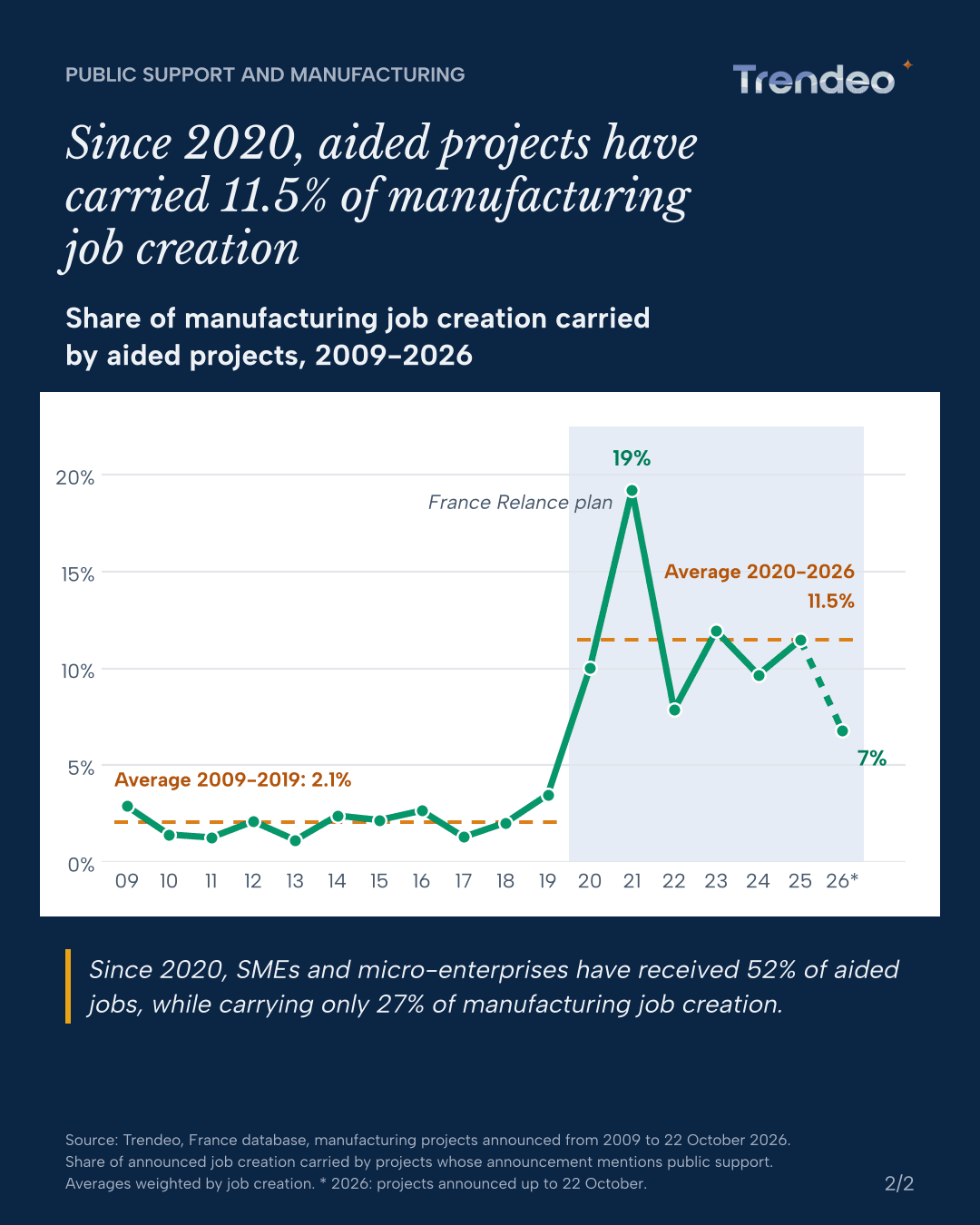
The timeline is clear: from 2009 to 2019, aided industrial projects accounted for 2.1% of industrial job creation; since 2020, they account for 11.5%, with a peak of 19% in 2021. In 2026, the share falls back to 7%.
One of the questions these aid schemes raise is that of deadweight loss: are they funding projects that would have gone ahead anyway?
We measured, by company size, how much total employment (both aided and non-aided) rises when aided employment rises by 1. With full deadweight loss, total employment does not move at all: the aided jobs simply replace jobs that would have been created without any support. If the aid is fully additional, total employment rises by at least as much as aided employment.
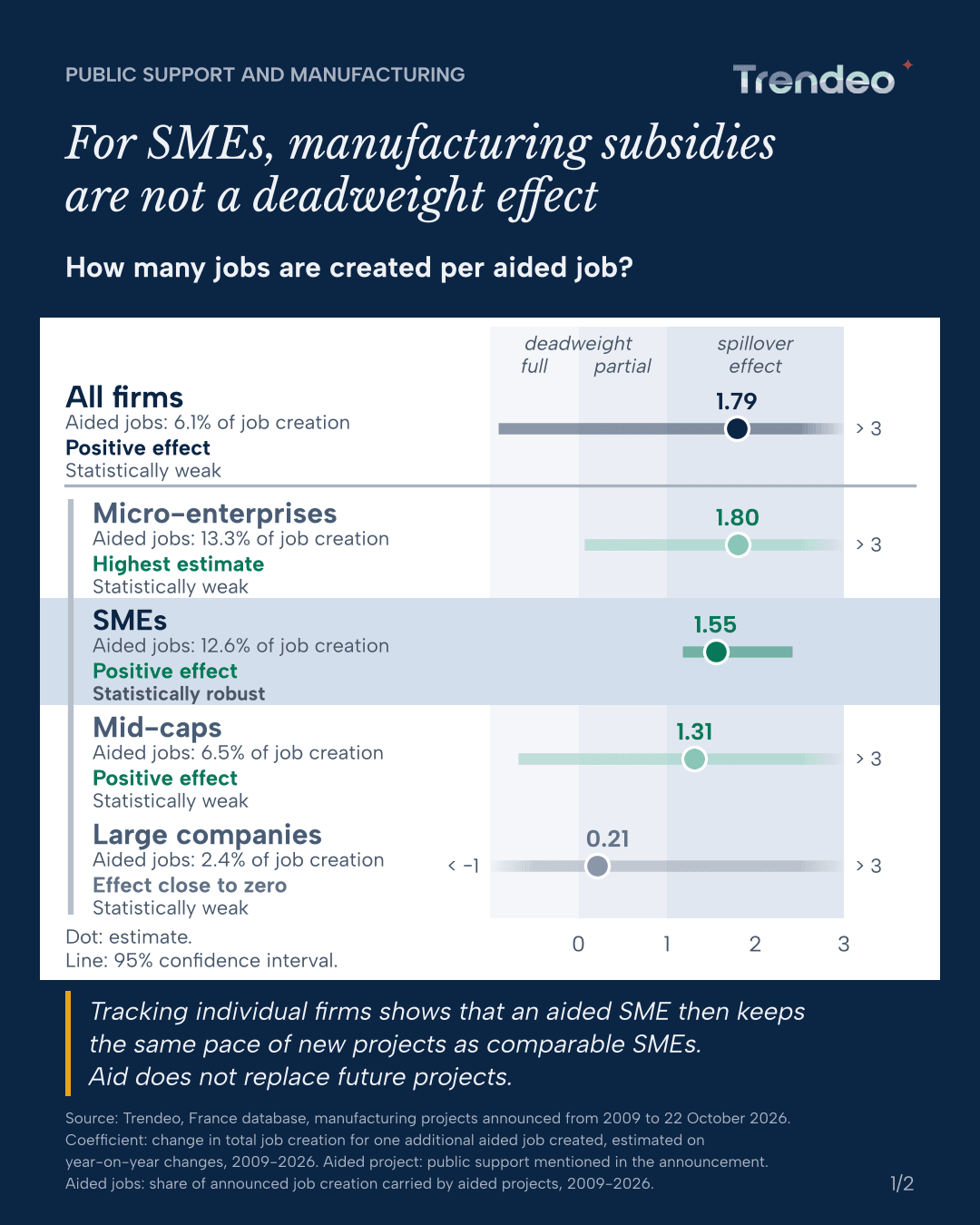
For SMEs, the result is clear-cut: 1.55 jobs in total for each aided job, with a confidence interval that rules out deadweight loss. Firm-level analysis points in the same direction: an aided SME subsequently keeps up the same pace of non-aided projects as a comparable SME. The aid adds to its other projects.
For micro-enterprises and mid-caps, the estimate is positive but statistically fragile. For large companies, it is close to zero and remains consistent with full deadweight loss.
Across industry as a whole, the aggregate estimate stands at 1.79 jobs per aided job, but it is statistically fragile — precisely because it blends very contrasting dynamics across company sizes.
This gap between company sizes does not stem from aid rates: the median aid rate is 28% for SMEs and 20% for large companies, and the cost per announced job hovers around €40,000 across all size brackets.
A minimal conclusion emerges: if public aid to companies is to be scaled back, then, on the criterion of job creation, priority should be given to preserving the schemes that benefit SMEs and micro-enterprises.
First conversation
See what Trendeo data changes for you
30 minutes to explore our databases against your real use case. Prefer to write? The form gets a reply within 24 working hours.
- A demo on your sector
- Custom quotes and exports
- An answer from an expert, not a robot

David Cousquer
Founder of Trendeo
He is the one who meets with you.
Write to us